
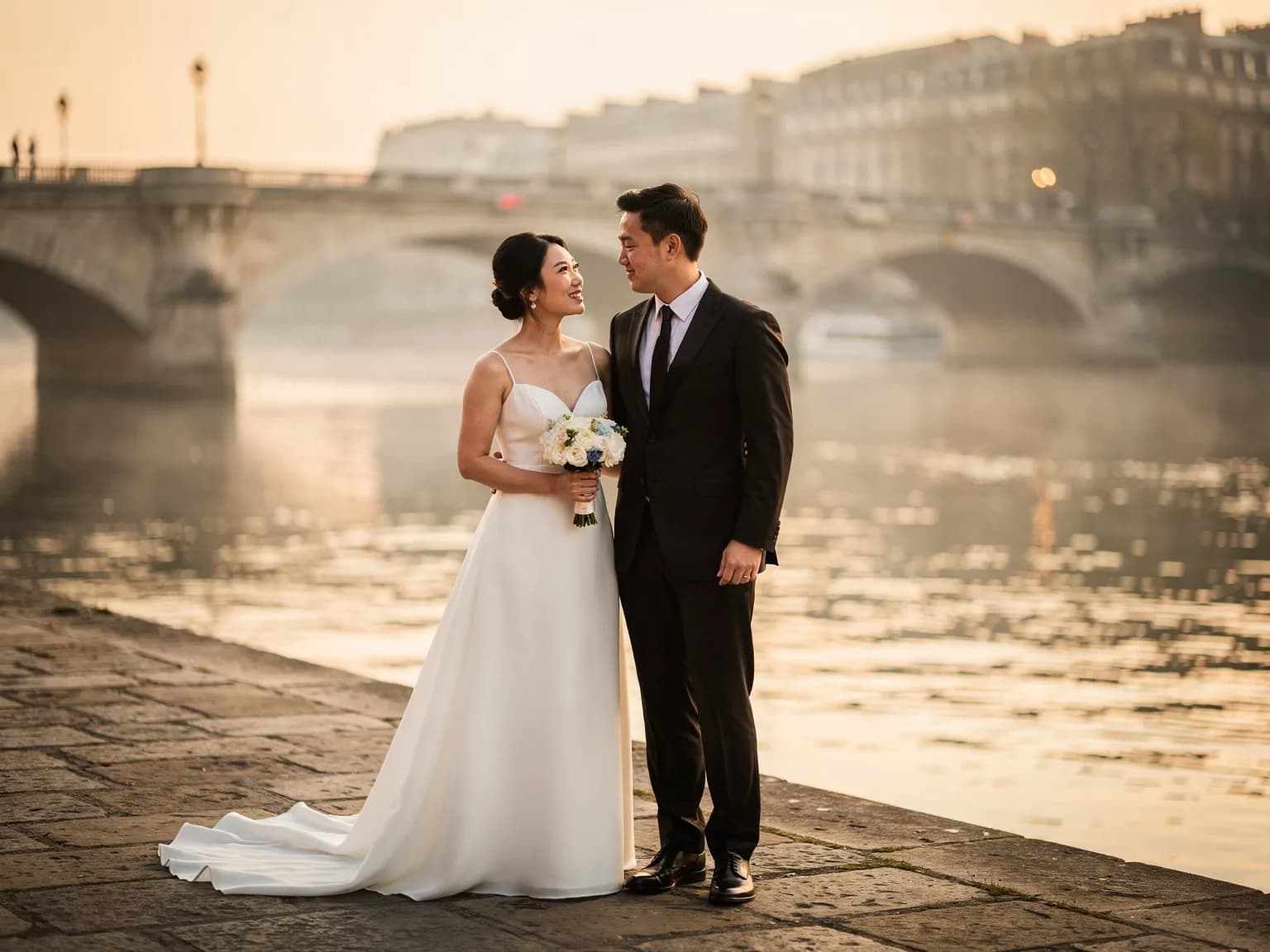
Eloping in Paris: the Honest Guide (Legality, Flow, Places and the Right Hours)
What a Paris elopement really is: what French law allows (and does not), how a typical morning unfolds, the places that work, the hours that make the images — no fantasy, no bad surprise.
What exactly is an elopement?
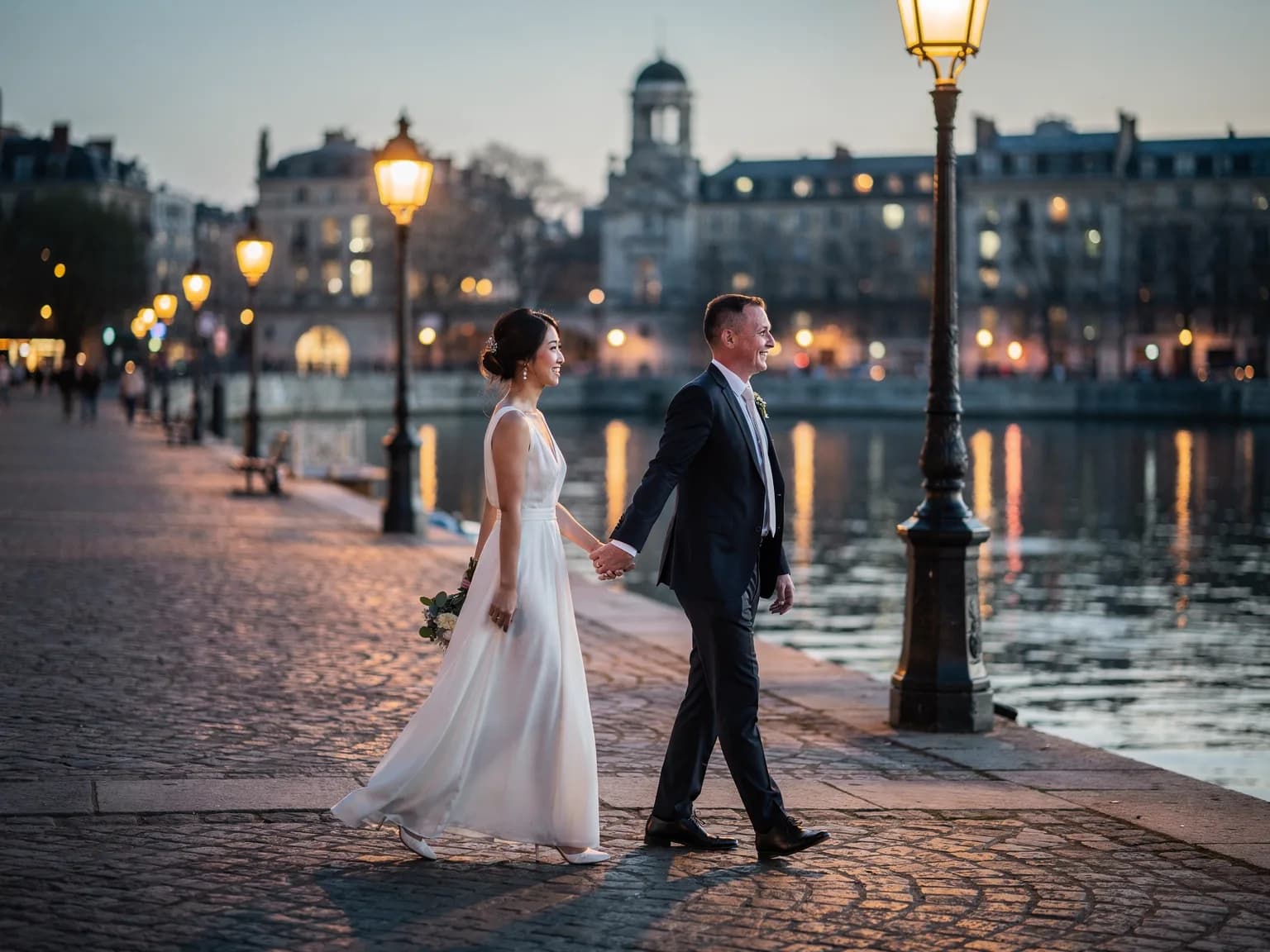
An elopement is a wedding deliberately reduced to the essential: the couple, sometimes one or two loved ones, a short ceremony, and a day designed to be lived rather than orchestrated. In Paris it has become a format in its own right, chosen as much by couples from abroad coming to say yes to each other with the city as a witness, as by French couples who prefer intimacy to a big evening.
- •It is not a cut-price wedding — it is a trade-off: all the budget and attention go to the moment, not the logistics.
- •The coverage IS the witness — without 80 guests to remember it, the images become the day's memory; it is the format where photography weighs the most.
- •Paris suits it beautifully — provided you choose the right hours and the right places, detailed below.
Legally marrying in Paris when you come from abroad: what the law actually says
This is the point too many couples discover three weeks before the date: French civil marriage requires a connection to the commune — domicile or residence of one spouse or a parent — plus publication of the banns. A foreign couple with no ties in France therefore generally cannot marry civilly here during a short stay. The vast majority of Paris elopements are symbolic ceremonies: the legal union happens in the home country, the commitment ceremony is lived in Paris.
- •A symbolic ceremony is no consolation prize — officiant, written vows, ring exchange: the moment is identical, only the register differs.
- •For French couples — the civil wedding happens in your commune of connection; nothing prevents living the session and a symbolic ceremony in Paris the same day or another.
- •The authoritative source — the conditions of French civil marriage are detailed on service-public.fr; be wary of pages promising a fast-track legal wedding in Paris.
The Paris elopement photographer page details this legal framework and the full flow of a symbolic ceremony in the capital.
Where to live your elopement in Paris
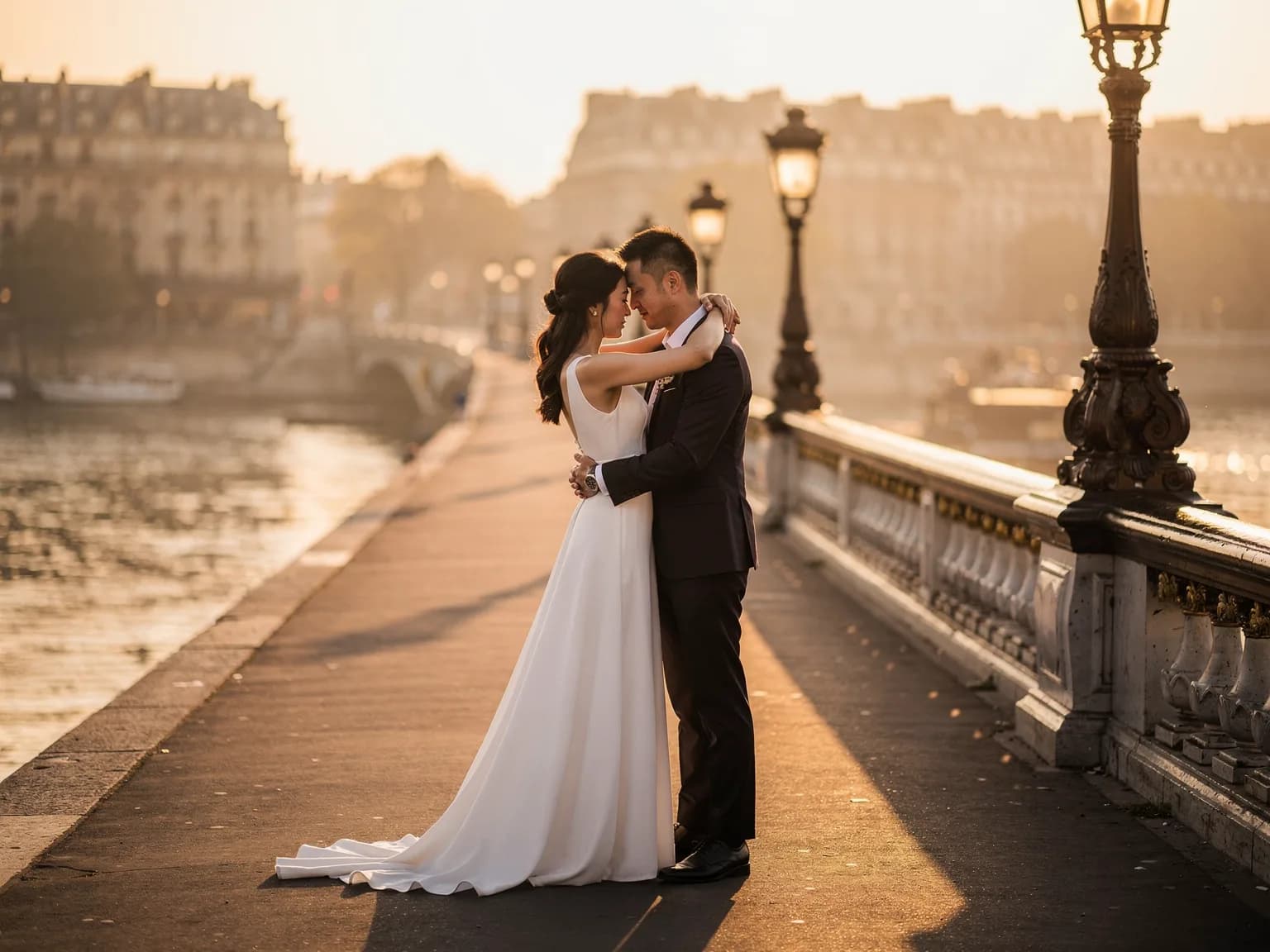
The right elopement spot is not the most famous one: it is the one that stays beautiful when you are alone in it. In Paris that means composing between the icons — deserted at dawn only — and the second-string settings the crowds ignore: lower quays, lanes, gardens, covered passages. A route of two or three nearby places beats a marathon across six arrondissements.
- •The lower Seine quays — water, bridges, skimming light: the elopement setting par excellence, to be lived early.
- •The lanes and stairways of Montmartre — village intimacy above the city; deserted at dawn, impossible at noon.
- •Gardens and covered passages — pockets of calm for the vows; some managed places (gardens, palaces, museums) have their own session rules: check them beforehand, not that morning.
- •A word on drones: in Paris, it is no by default — the capital sits inside the LF-P 23 prohibited zone; a formal authorisation from the Police Prefecture exists on paper but falls outside the scope of an ordinary wedding. In practice, aerial views happen elsewhere in the region, as the Paris-region drone wedding photography page explains.

A typical elopement morning, hour by hour
A successful Paris elopement is almost always a morning affair: the city is empty, the light is soft, and the day is still ahead of you. The typical flow has four movements, and its main virtue is not being timed to the minute — it is a frame, not a countdown.
- •Getting ready (1 h) — at the hotel or apartment: the details, the outfits, the calm before — often the day's most intimate images.
- •The ceremony (30 min) — vows and rings in the chosen place, alone or with your few loved ones.
- •The session through the city (1.5 h) — two or three nearby settings, on foot: the images in motion that tell Paris.
- •The open celebration — brunch, a rooftop toast, lunch: the coverage can continue there or stop, it is your day.
Best window: sunrise → 10 am · Best seasons: April-June, September-October
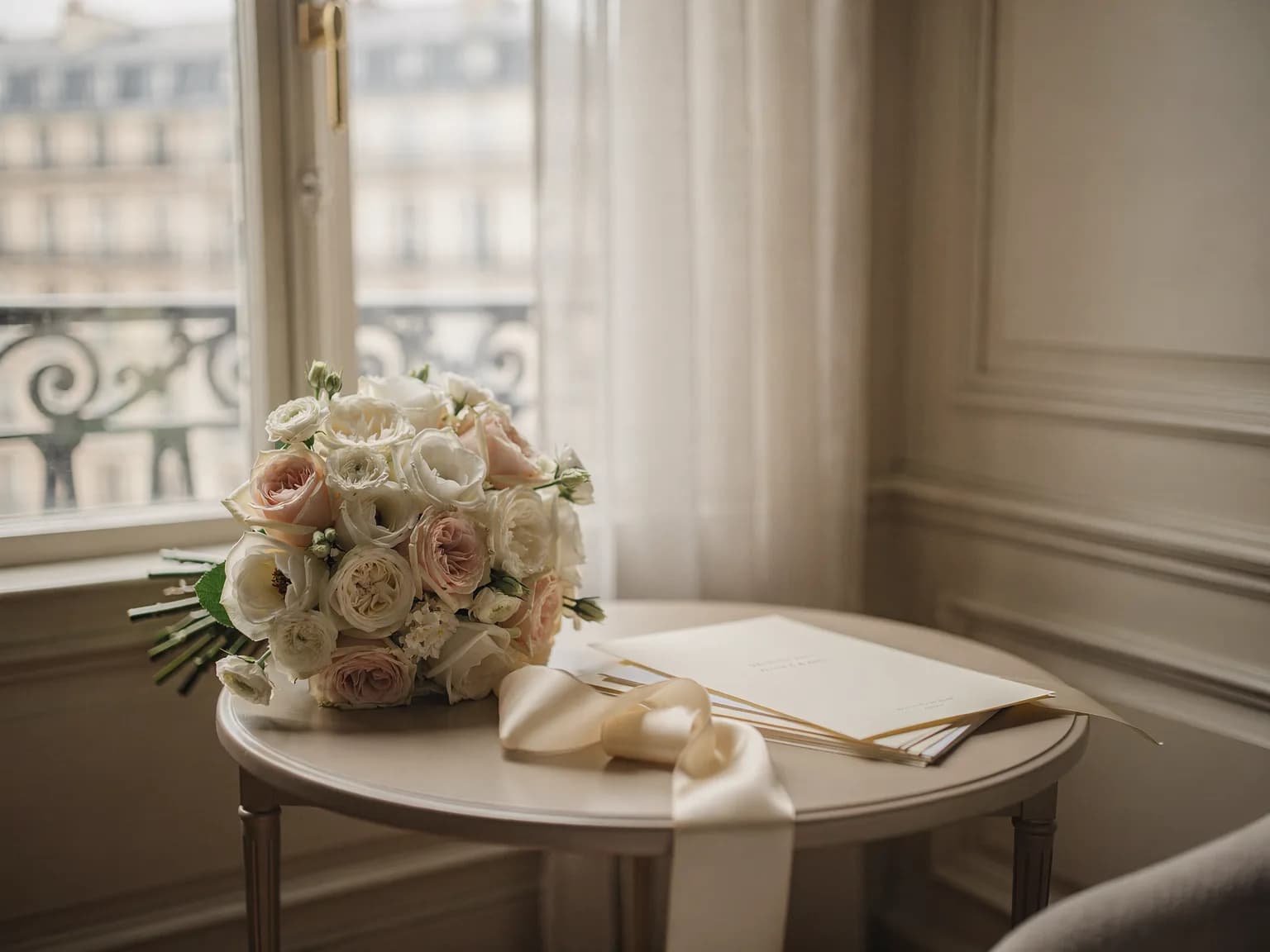
Preparing your elopement well: what gets decided upstream
The lightness of the day is paid for in preparation — but not much of it: an elopement comes together in two to three months where a classic wedding takes eighteen. Five decisions concentrate the essentials.
- •Date and hour first — sunrise dictates everything else; a Sunday or weekday at dawn beats any Saturday.
- •The legal or symbolic frame — settled early (see above), it stops weighing on the day at all.
- •The officiant, if symbolic — a bilingual professional or a loved one who knows you: both work, the point is to choose, not improvise.
- •The rain plan — covered passages, a hotel conservatory, the apartment: Paris in the rain photographs beautifully, provided you have decided where.
- •The photographer, early — in this format they are the only supplier present start to finish; their scouting of places and hours IS the day's preparation.
A Paris elopement keeps a rare promise: a wedding fully lived, in a city that gives itself to those who rise early. The condition is honesty about the frame — an assumed symbolic ceremony for couples from abroad, a civil wedding in your commune for the French — and short but real preparation. The detail of the format, legal frame included, is on the Paris elopement photographer page; to talk about it concretely, the quote is free and without obligation.
Your questions, my answers
Can you legally marry in Paris coming from abroad?
Generally not during a short stay: French civil marriage requires a commune connection (domicile or residence of a spouse or parent) plus publication of the banns. Most foreign couples hold the legal union at home and live a symbolic ceremony in Paris — identical in the experience, different in the register.
What is the best hour for a Paris elopement?
Sunrise, without hesitation: the iconic places are deserted, the light is the day's finest, and the city is yours until 9 or 10 am. It is the only slot where a Seine bridge can be all yours.
How long does an elopement take to prepare?
Allow two to three months: the minimum booking lead time for the coverage is 2 months, and that is usually what drives the calendar — the logistics themselves (date, places, an officiant if needed, rain plan) come together in a few weeks. Since dawn slots are less contested than peak-season Saturdays, you do not need the 12 to 18 months of a classic wedding.
Can you get drone images for a Paris elopement?
Not by default: Paris sits inside the LF-P 23 prohibited zone. A formal authorisation request to the Police Prefecture exists, but it belongs to an exceptional framework outside an ordinary wedding. Aerial views remain possible elsewhere in the Paris region, under conditions — the detail is on the Paris-region drone wedding photography page.
Stay inspired
Receive my latest photos and tips for your wedding.
Have a project in mind?
Contact me to discuss your wedding and create unforgettable memories together.
Contact me